
Technical
Technical AEO that lets answer engines reach, read and quote your site
Technical AEO is the crawler access and page structure work that decides whether ChatGPT, Perplexity, Claude and Google's AI features can fetch your pages at all. It is for marketing and web teams who suspect a robots.txt rule, a CDN setting or a script-heavy template is keeping them out of AI answers. You get a token-by-token access review, rendering and schema fixes, and proof in your server logs that the right bots now get through.
Get a free AEO visibility check
Two lines is enough. A specialist replies within one business day.
Quick answer
What is technical AEO?
Technical AEO is the work that makes your pages reachable and readable by answer engines: allowing search crawlers such as OAI-SearchBot, PerplexityBot and Claude-SearchBot in robots.txt and firewall rules, serving the main text in plain HTML, keeping schema accurate and submitting new URLs quickly. It does not earn citations by itself, but content cannot be cited without it.
- Blocking GPTBot opts you out of OpenAI model training, not out of ChatGPT search answers.
- Google says AI Overviews only need a page that is indexed and eligible for a snippet.
- Cloudflare now blocks AI training crawlers by default on new domains, so settings deserve a check.
- We confirm every access fix in raw server logs, not only in the robots.txt file.
What does technical AEO cover that content work does not?
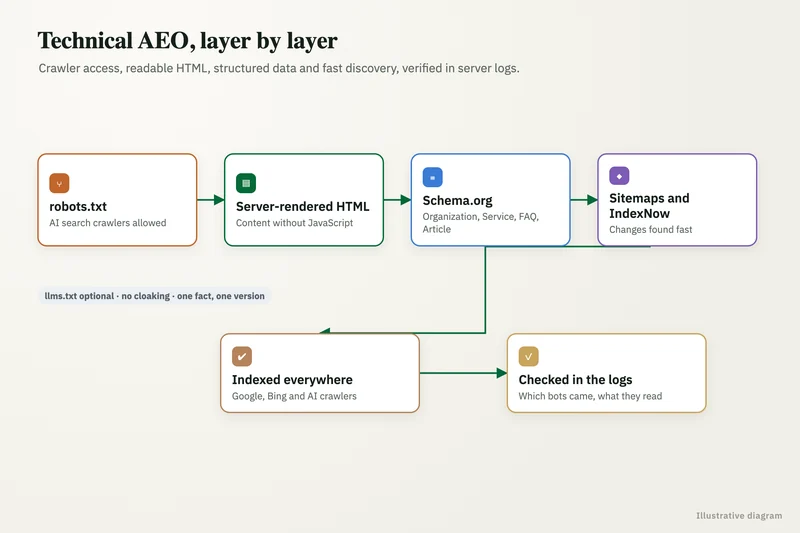
It covers everything between an answer engine's crawler and your words: permissions, delivery, markup and discovery. Content restructuring decides what a page says; this layer decides whether a machine ever receives it.
We treat it as a separate workstream because the failures are silent. A site can rank well in classic search while a single disallow line, a bot-fight rule at the CDN or an empty pre-render shell keeps one or more answer engines out. Our AEO audit flags these problems; this service fixes them and keeps them fixed after every redesign, migration or security change.
- robots.txt rules for every search, user-fetch and training token.
- CDN and web application firewall rules that sit in front of robots.txt.
- Server-rendered HTML for the main answer on each important page.
- Organization, Product, Article and FAQ schema that matches what visitors see.
- XML sitemaps, last-updated dates and IndexNow pings for fresh content.
Which AI crawlers should you allow in robots.txt?
Allow the crawlers that put pages into answers, then make a separate business decision about training crawlers. Mixing the two up is the most common mistake we see in AI crawler access.
OpenAI's crawler documentation says OAI-SearchBot surfaces sites in ChatGPT search, follows robots.txt and picks up changes in about 24 hours, while sites that opt out are not shown in search answers. GPTBot collects training data, and blocking it only opts you out of training. Perplexity's bot guide describes PerplexityBot as a search crawler that is not used for training. Anthropic lists Claude-SearchBot for search quality and ClaudeBot for training. Google's crawler documentation explains that AI Overviews and AI Mode use Googlebot, and that Google-Extended is a control token, not a crawler, covering Gemini training and Gemini Apps grounding without affecting Google Search. Bingbot crawls for Copilot; there is no separate Copilot crawler.
- Keep allowed for visibility: Googlebot, Bingbot, OAI-SearchBot, PerplexityBot, Claude-SearchBot, Applebot.
- User-triggered fetchers: ChatGPT-User, Perplexity-User, Claude-User.
- Training-only controls you may block: GPTBot, ClaudeBot, Google-Extended, Applebot-Extended, CCBot.
What you get
What we deliver
Scoped and quoted at a fixed price after a free review.
Crawler access map
A table of every AI search, user-fetch and training token, what your robots.txt, CDN and firewall currently do with each, and what they should do.
robots.txt and CDN fixes
Edited robots.txt plus Cloudflare or firewall rule changes, written so search crawlers stay allowed and training choices are explicit.
Rendering review
Template-by-template check of what arrives in raw HTML, with fixes for answers that only appear after scripts run.
Schema cleanup
Organization, Product, Article and FAQ markup aligned to visible content, with sameAs links for entity consistency.
Discovery setup
XML sitemaps with accurate lastmod dates, IndexNow submission and Search Console plus Bing Webmaster Tools verification.
Log verification report
Before and after server log evidence showing which AI crawlers fetched which URLs and with what status codes.
Is Cloudflare blocking AI crawlers on your site?
It may be, even if your robots.txt looks open. Cloudflare changed its default on 1 July 2025 to block AI crawlers unless they pay, and its June 2026 bot report says AI training crawlers are blocked by default for all new domains, noting that training makes up 52% of crawler requests.
Cloudflare's managed robots.txt can add a content signal line such as search=yes, ai-train=no and disallow GPTBot, ClaudeBot, Google-Extended, Applebot-Extended and CCBot. That is a sensible setup for many brands, but we check that the search crawlers stay allowed in the dashboard rules too. Pay per crawl can answer a crawler with HTTP 402 Payment Required, which is worth knowing if your logs show 402s to bots you meant to welcome. We also note that Cloudflare reported Perplexity using undeclared crawlers in August 2025 and delisted it as a verified bot, so rules that only admit verified bots need a deliberate decision about PerplexityBot.
Does schema markup for AI help you get cited?
Not directly, and we will not sell it as a citation lever. Google's AI optimization guide says structured data is not required for generative AI search and there is no special schema.org markup to add, while recommending you keep using it for general SEO.
We still implement schema carefully because it states your entity facts in one consistent place. Organization markup with sameAs links to your LinkedIn, Wikidata, G2 or Google Business Profile listings helps keep your name, category and locations consistent wherever you appear. Google's guidance on succeeding in AI search adds that structured data must match visible content, so we remove FAQ or review markup that describes text the visitor cannot see.
How should pages be built so answer engines can read them?
Put the answer in the HTML the server sends, near the top, under a heading that matches the question. We do not assume every crawler executes JavaScript, so we test each key template with scripts turned off and fix anything that disappears.
Beyond rendering, we check canonical tags, status codes, redirect chains and duplicate paths, because a crawler that wastes fetches on parameters or soft 404s may never reach the page you want quoted. Each important page gets a visible last-updated date, a clean heading outline and tables in real table markup rather than images. Google states no special files, markup or Markdown copies are needed, and it does not require breaking content into tiny pieces, so we keep pages whole and readable.
How do you confirm the fixes actually worked?
We read the server logs. A robots.txt change proves intent; a 200 response to OAI-SearchBot, PerplexityBot or Claude-SearchBot on the right URLs proves access.
We match user agents against published IP ranges where vendors provide them, as Perplexity does, so spoofed bots do not distort the picture. Then we submit updated sitemaps, ping IndexNow for Bing, and watch Search Console's generative AI performance report and Bing Webmaster Tools AI Performance for cited pages. Ongoing citation reporting sits with our AI visibility tracking service.
Do you need an llms.txt file?
You can add one cheaply, but do not expect it to change citations. Jeremy Howard of Answer.AI proposed llms.txt in September 2024, and Google's John Mueller said none of the AI services have said they are using it, comparing it to the meta keywords tag.
It is genuinely useful for developer documentation that coding agents read, which is why AI companies publish one for their own docs. For a marketing site, we treat it as an optional tidy-up after the real access work is done.
How it works
How an engagement runs
- 01
Pull logs and settings
We collect 30 days of server or CDN logs, robots.txt, firewall rules and Search Console access.
- 02
Map crawler access
We test each token against your live rules and record where search crawlers are blocked, challenged or charged.
- 03
Fix and deploy
We ship robots.txt, CDN, rendering and schema changes with your developers, or directly where we have access.
- 04
Verify in logs
We confirm 200 responses for the right bots on the right URLs and hand over a short change record.
- 05
Recheck after releases
We rerun the checks after redesigns, migrations or security changes, when access most often breaks.
FAQ
Frequently asked questions
Should I block GPTBot and ClaudeBot?
That is a business choice about model training, not about search visibility. OpenAI says blocking GPTBot only opts you out of training, and ChatGPT search relies on OAI-SearchBot instead. Anthropic separates ClaudeBot for training from Claude-SearchBot for search, so you can block one and allow the other.
What is the difference between GPTBot, OAI-SearchBot and ChatGPT-User?
GPTBot gathers training data, OAI-SearchBot surfaces sites in ChatGPT search, and ChatGPT-User fetches a page when a user asks ChatGPT to. OpenAI notes that ChatGPT-User is not used for indexing and may not follow robots.txt. Allow OAI-SearchBot if you want to appear in ChatGPT search answers.
Does blocking Google-Extended remove my site from AI Overviews?
No. Google's crawler documentation says Google-Extended does not affect inclusion in Google Search and is not a ranking signal. AI Overviews and AI Mode use Googlebot, so blocking Google-Extended only affects Gemini training and Gemini Apps grounding.
How long does technical AEO take?
Most access and robots.txt fixes can ship within days once we have log and CDN access. OpenAI says OAI-SearchBot picks up robots.txt changes in about 24 hours. Rendering and schema work depends on how many templates your site uses and how quickly your developers can release changes.
Is schema markup required to appear in AI answers?
No. Google's AI optimization guide says structured data is not required for generative AI search and no special markup exists for it. We still keep schema accurate for regular search features and for consistent entity facts, and we make sure it matches what visitors can see.
Can crawler fixes alone get my brand cited?
No one can promise a citation, and access fixes only remove barriers. Answer engines still choose sources based on the content and the reputation around it. Technical work makes sure that when your pages deserve to be quoted, nothing stops the crawler from reading them.
Keep reading
Related pages
Get started
Find out what AI says about you
Send your website and three questions your buyers ask. Within one business day we reply with how ChatGPT, Google AI Overviews and Perplexity answer them today, who they cite instead of you, and a fixed-price plan.
- Free AEO visibility check
- Fixed quote before any work starts
- Measured on citations and AI referrals, not promises
Prefer email? info@aeoservicesagency.com
Get a free AEO visibility check
Two lines is enough to start.