
Comparison guide
AEO vs SEO: how they differ, where they overlap and what to do first
AEO vs SEO is less a contest than a question of emphasis: both depend on crawlable, useful pages, but they aim at different outcomes and are measured differently. This guide is for marketing and growth leads deciding how to split effort between classic rankings and AI answers, and it includes a side-by-side table that adds GEO to the comparison.
Get a free AEO visibility check
Two lines is enough. A specialist replies within one business day.
Quick answer
What is the difference between AEO and SEO?
The AEO vs SEO difference is the target. SEO works to rank pages in search results and win clicks. AEO works to get a brand cited or recommended inside AI answers from ChatGPT, Google AI Overviews, Perplexity and Copilot. AEO builds on SEO foundations, then adds answer-first content, entity work, mentions and citation tracking.
- SEO earns rankings and clicks; AEO earns citations and mentions inside written AI answers.
- Google states that optimizing for generative AI search is still SEO at its core.
- Brand mentions correlate with AI Overview visibility far more strongly than backlinks do.
- Fix crawlability and indexing first, then add answer-specific work and citation tracking.
What is the core difference in AEO vs SEO?
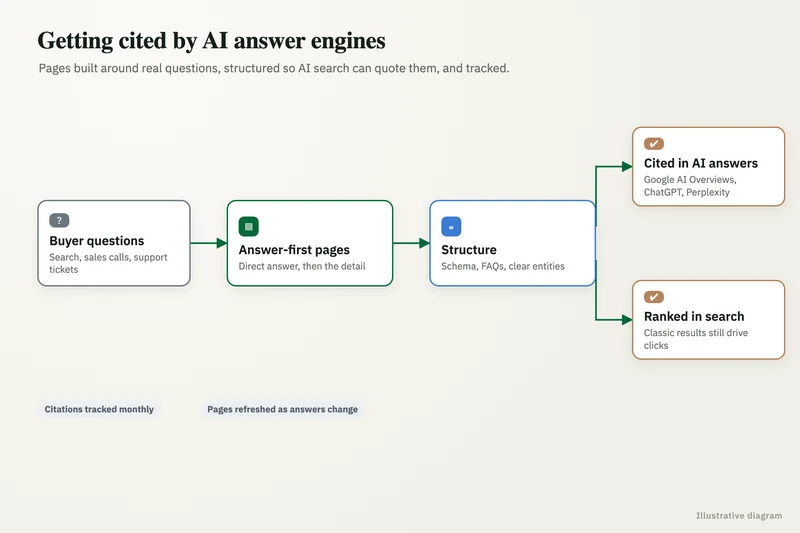
SEO is about position in a list; AEO is about inclusion in a paragraph. A classic search result rewards the page that best matches a query with a high slot and a click. An AI answer blends several sources into one reply, names a handful of brands and links a few pages, and the buyer may never scroll to the links.
That shift changes what success looks like. In SEO you track rankings, impressions and organic sessions. In AEO you track whether your brand appears in answers to the prompts your buyers use, how often your URLs are cited, how your company is described and how many visits arrive from chatgpt.com, perplexity.ai or copilot.microsoft.com. The work underneath overlaps heavily, but the scoreboard is different.
How do AEO, SEO and GEO compare side by side?
The three labels share most of their foundations and split mainly on target and measurement. The table below sets them out; GEO and AEO are often used as synonyms, so treat the GEO column as the content-focused slice of the same goal.
If you only remember one row, make it the measurement row. Teams that keep reporting only rank positions often miss that they have been dropped from, or added to, the answers their buyers read.
| SEO | AEO | GEO | |
|---|---|---|---|
| Goal | Rank pages in search results and earn clicks | Get the brand cited or recommended in AI answers | Get content quoted inside generative answers |
| Where it shows | Google and Bing results pages | ChatGPT, AI Overviews, AI Mode, Perplexity, Copilot, Gemini, Claude | Mostly the same AI answer surfaces |
| Main units | Pages and keywords | Questions, passages and brand entities | Passages and claims |
| Key crawlers | Googlebot, Bingbot | Googlebot, Bingbot, OAI-SearchBot, PerplexityBot, Claude-SearchBot | Same as AEO |
| Off-site signals | Backlinks, local listings | Mentions on Reddit, YouTube, LinkedIn, review sites, Wikipedia | Citable data and expert sources |
| Measurement | Rankings, clicks, organic sessions | Citation share, prompt-set results, AI referrals in GA4 | Citation and quote frequency |
| Foundations | Crawlability, indexing, quality content | All SEO foundations first | All SEO foundations first |
Is AEO just SEO, according to Google?
For Google's own AI features, largely yes. Google's AI optimization guide, updated in July 2026, says optimizing for generative AI search "is still SEO" and that no special files, markup or Markdown are needed, and it does not require breaking content into tiny pieces.
Google's AI features documentation adds that a page only needs to be indexed and eligible for a snippet to appear in AI Overviews or AI Mode, with no additional requirements. So for Google, technical SEO and helpful content remain the price of entry.
The picture widens outside Google. ChatGPT, Perplexity and Claude run their own crawlers, which robots.txt files and CDN settings often block by accident. They also pull heavily from forums, video and review platforms. That is the ground AEO covers that a Google-only SEO program can miss.
Does ranking in Google still get you cited in AI answers?
It helps, but less than many teams assume. Ahrefs found that 38% of AI Overview citations come from pages in the top 10, down from 76% a year earlier, so a top ranking is no longer a reliable ticket into the overview.
The engines appear to cast a wider net, partly because of query fan-out: Google's documentation explains that AI features may run several related searches across subtopics before showing supporting links. A page that answers one of those sub-questions directly can be cited even if it does not rank for the head term. That rewards specific, well-structured pages over broad ones that try to cover everything.
Do backlinks or brand mentions matter more for AEO?
Mentions appear to matter more. In an Ahrefs study of 75,000 brands, web mentions correlated 0.664 with AI Overview visibility, against 0.218 for backlinks.
Correlation is not proof of cause, but it matches what practitioners see: answer engines summarize what the web says about a brand, so being discussed on Reddit, reviewed on G2 or Capterra, covered in trade press and present on Wikipedia or Wikidata shapes how you are described. Backlinks still matter for SEO and for discovery. For AEO, the question becomes who talks about you, where and in what words. Google's guide warns against inauthentic mentions, so this is earned work, not a link scheme.
How does page structure differ for AEO and SEO?
AEO pages put the answer first and keep each section self-contained. SEO pages can rank with a long build-up; answer engines tend to lift a clear passage, so a buried answer is easy to skip.
In practice that means H2s phrased the way buyers ask, such as "How much does payroll software cost for 50 employees?", followed by one or two sentences that answer it without needing the paragraph before. Detail, caveats and examples follow underneath. FAQ blocks work for the same reason: each answer stands alone. Comparison pages and alternatives pages earn citations because buyers ask comparative questions and the engines need a source that lays out the trade-offs plainly.
Freshness signals matter more too. Visible last-updated dates, current pricing and dated original data give an engine a reason to prefer your page over an older summary. None of this conflicts with SEO. Google's guide simply says you do not need to chop content into tiny fragments, so the aim is clarity, not a page of disconnected snippets.
Which metrics change when you add AEO to SEO?
You keep your SEO metrics and add citation-focused ones. Clicks are not the whole story, because a brand can shape a buyer's shortlist inside an answer without a visit.
Seer Interactive reported that brands cited in an AI Overview earned 35% more organic clicks than those not cited, and Semrush estimated the average AI search visitor is worth 4.4 times an organic visitor. Both are good reasons to track AI traffic separately rather than burying it in referrals.
- Search Console generative AI performance report for impressions and clicks from Google's AI features.
- Bing Webmaster Tools AI Performance for Copilot citations, cited pages, grounding queries and citation share.
- GA4 referrals from chatgpt.com, perplexity.ai, copilot.microsoft.com and gemini.google.com, grouped as one channel.
- A fixed prompt set run monthly in each engine, recording which brands and URLs are cited.
Should you invest in AEO or SEO first?
Fix SEO foundations first, then layer AEO on top. If pages are not indexed, render only in JavaScript or block key crawlers, no amount of answer-first rewriting will help.
A sensible sequence looks like this: confirm Googlebot, Bingbot, OAI-SearchBot, PerplexityBot and Claude-SearchBot can reach your pages, and check Cloudflare's AI crawler settings and your server logs. Then restructure the pages that answer buyer questions so the answer sits in the first lines under a question-style heading. Then align your company facts across your site, Organization schema with sameAs links and the directories your industry uses. Finally, build genuine mentions and start a monthly prompt-set report. Most of that work also improves classic rankings, which is why the two budgets rarely compete as much as they seem to.
Can one team handle both AEO and SEO?
Yes, if the team adds a few skills. An in-house SEO team already owns crawlability, content and reporting; AEO asks them to also manage AI crawler rules, entity data, community and review presence, and prompt-based tracking.
Where we see gaps, they are usually in measurement and off-site work rather than in writing. Many SEO teams have never pulled AI referrals into their own GA4 channel or opened Bing's AI Performance report, and few have a routine for Reddit, YouTube or review-site presence. An outside AEO partner can set those up and hand them over, or run them as an ongoing program.
FAQ
Frequently asked questions
Will AEO replace SEO?
No. AEO depends on SEO, since AI features in Google use the same index and other engines still need crawlable, clear pages. What changes is the target: you now want to be cited in answers as well as ranked in results, and you need metrics for both.
What is the difference between AEO and GEO?
The terms overlap almost completely. GEO, generative engine optimization, is often used for content-level work to get passages quoted in generative answers. AEO is usually the broader label that also includes technical access, entity consistency, mentions and tracking.
Does schema markup help with AEO?
Schema helps general SEO and keeps your company facts machine-readable, but Google says structured data is not required for generative AI search and there is no special schema for it. Use it where it matches visible content, and do not treat it as a citation lever.
Can my SEO agency do AEO?
Some can. Ask whether they check AI crawler access in robots.txt and Cloudflare, track a fixed prompt set across engines, report citation share from Bing Webmaster Tools and separate AI referrals in GA4. If they only report rankings, the AEO side is probably missing.
Should I block GPTBot if I care about AEO?
Blocking GPTBot only opts your content out of OpenAI model training, according to OpenAI's crawler documentation. ChatGPT search visibility depends on OAI-SearchBot, which is a separate token. Many businesses block training crawlers and keep search crawlers allowed, so check each token rather than blocking all AI bots at once.
Is AI search traffic worth more than organic traffic?
Some studies suggest so. Semrush estimated in June 2025 that the average AI search visitor is worth 4.4 times an organic visitor. Your own GA4 data is the better guide, so set up an AI referral channel and compare conversion rates directly.
Keep reading
Related pages
Get started
Find out what AI says about you
Send your website and three questions your buyers ask. Within one business day we reply with how ChatGPT, Google AI Overviews and Perplexity answer them today, who they cite instead of you, and a fixed-price plan.
- Free AEO visibility check
- Fixed quote before any work starts
- Measured on citations and AI referrals, not promises
Prefer email? info@aeoservicesagency.com
Get a free AEO visibility check
Two lines is enough to start.