

Google AI
AI Overviews optimization for brands that want to be the cited link
Our AI Overviews optimization service helps your pages become the supporting links Google shows inside AI Overviews and AI Mode. It is for teams whose informational traffic is flattening while Google answers more questions on the results page, and who want a plan grounded in what Google has actually published. You get an eligibility check, a topic coverage map built around query fan-out, page rewrites and reporting from Search Console's generative AI data.
Get a free AEO visibility check
Two lines is enough. A specialist replies within one business day.
Quick answer
How do you get your content into Google AI Overviews?
AI Overviews optimization starts with Google's stated rule: a page only needs to be indexed and eligible to show a snippet, with no special markup or files. From there, the work is covering the related subtopics Google searches during query fan-out, opening each section with a direct answer, keeping facts current and building a reputation that earns genuine mentions.
- Google says optimizing for its AI features is still SEO, with no extra requirements.
- Query fan-out means Google searches related subtopics, so coverage beats single-keyword pages.
- Blocking Google-Extended does not remove you from AI Overviews; Googlebot does that crawling.
- Search Console now reports generative AI impressions and clicks, so results can be measured.
What does Google say it takes to appear in AI Overviews?
Very little beyond good SEO. Google's documentation on AI features says a page needs to be indexed and eligible to show a snippet, that there are no additional requirements, and that no special optimizations are needed.
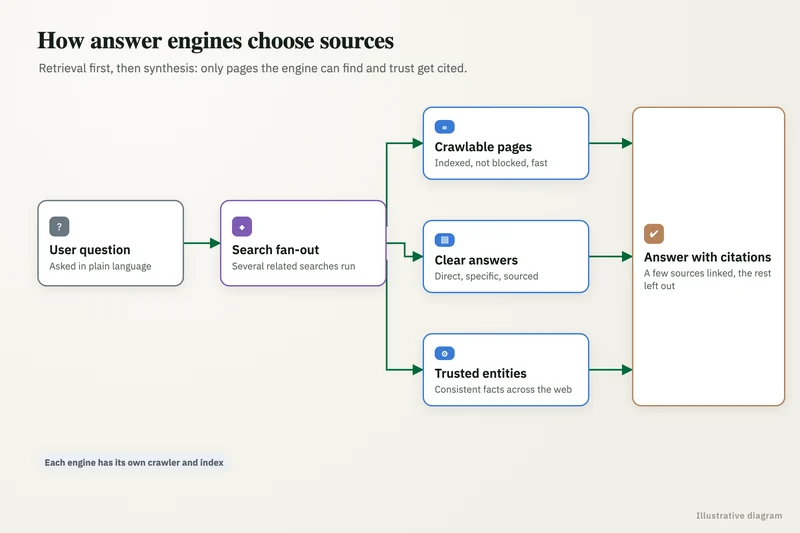
Google's AI optimization guide, updated in July 2026, goes further: optimizing for generative AI search is still SEO, no special files, markup or Markdown are needed, and content does not have to be broken into tiny pieces. We take that at face value. Before any AI-specific work, we confirm your key pages are indexed, not blocked by noindex or robots rules, render their main text for Googlebot and carry no snippet restrictions you did not intend.
How does query fan-out change AI Overviews optimization?
It rewards pages that cover the neighboring questions, not just the headline query. Google says AI Overviews and AI Mode may run several related searches across subtopics and then show supporting links from what they find.
That helps explain why AI Overview citations do not simply mirror the top ten. Ahrefs found 38% of AI Overview citations come from the top 10 results, down from 76% a year earlier. A page ranking on page two for the main query can still be cited if it answers one of the fan-out subtopics best. So we map each priority question into its likely subtopics, such as cost, comparison, risks, steps and eligibility, and check which of your pages answers each one clearly.
What you get
What we deliver
Scoped and quoted at a fixed price after a free review.
Eligibility check
Indexing, snippet controls, robots rules and Googlebot rendering reviewed for your priority pages.
Fan-out coverage map
Each priority question broken into likely subtopics, with the page that should answer each one and the gaps.
Page rewrites
Answer-first restructuring, sourced figures, comparison tables and last-updated dates on the pages that matter most.
AI Mode follow-up content
New or expanded sections for the second and third questions buyers ask after the overview.
Search Console AI reporting
A monthly view of generative AI impressions and clicks alongside your own prompt-set citation checks.
Page priority list
Candidate pages ranked by business value and effort, with merge recommendations for pages that compete for the same question.
How is Google AI Mode SEO different from AI Overviews?
It is mostly the same work, aimed at a longer conversation. At I/O 2026 Google merged the two into one flow: the overview appears first, and follow-up questions continue in AI Mode.
Follow-ups tend to be more specific than the opening query, so pages need depth on the second and third questions a buyer asks, not only the first. We build that depth with clear subheadings phrased as questions, tables for comparisons, and links between related pages so a follow-up can land on the right one. Both features use Googlebot, so the same access and indexing checks apply.
Does blocking Google-Extended affect AI Overviews?
No. Google's crawler documentation describes Google-Extended as a robots.txt control token, not a crawler, that governs Gemini training and Gemini Apps grounding, and says it does not affect inclusion in Google Search or act as a ranking signal.
We see teams block Googlebot paths by mistake while trying to opt out of AI training, and we see teams assume Google-Extended is the switch for AI Overviews. Neither is right. If you want out of Gemini training, use Google-Extended; if you want to stay in AI Overviews, keep Googlebot allowed.
What page changes help a page get used as a supporting link?
Pages that answer plainly, show their evidence and stay current are easier to quote. None of these are secret signals; they are the habits Google's guidance points toward anyway.
- A one or two sentence answer directly under each question heading.
- Specific figures with named sources, and original data where you have it.
- A visible last-updated date and a real review of stale facts.
- Structured data that matches visible content, as Google's AI search guidance requires.
- Clear authorship and company details that support E-E-A-T.
- Internal links between a pillar page and its subtopic pages.
Which pages should you work on first?
Start with the informational and comparison pages that already earn impressions for questions where an AI Overview appears. They are indexed, Google already trusts them for the topic, and small structural changes can make them easier to cite.
We rank candidate pages by business value and effort: pages that feed demo requests, bookings or product views come before general blog posts. Thin pages that compete with each other for the same question are merged, so one clear page carries the answer instead of three weak ones.
How do you measure AI Overview performance?
Start in Search Console. Google counts AI feature traffic within the Web search type, and since June 2026 its generative AI performance reports show impressions and clicks from these features.
We add a fixed prompt set run in AI Overviews and AI Mode each month, recording whether you are cited and which competitors appear. Comparing cited queries with organic click data shows where you earn a citation but lose the click, which tells us whether to rework the page or accept the visibility as brand exposure.
How it works
How an engagement runs
- 01
Confirm eligibility
We check that priority pages are indexed, snippet-eligible and readable by Googlebot.
- 02
Map the fan-out
We list the subtopics behind each priority question and match them to your pages.
- 03
Rewrite and fill gaps
We restructure existing pages and add missing subtopic content.
- 04
Baseline and track
We record current AI Overview and AI Mode citations, then rerun monthly.
- 05
Refine
We rework pages that are cited but lose clicks, and those still missing from answers.
FAQ
Frequently asked questions
Do I need special schema to appear in AI Overviews?
No. Google's AI optimization guide says structured data is not required for generative AI search and there is no special schema.org markup to add. Keep using structured data for regular search features, and make sure it matches the visible page.
How many people see Google AI Overviews?
Google said at I/O in May 2026 that AI Overviews has more than 2.5 billion monthly users. That reach is why many businesses now treat the cited links inside AI Overviews as a visibility goal of their own.
Can I see AI Overview clicks in Search Console?
Yes. Google counts AI feature traffic in the Web search type, and in June 2026 it added generative AI performance reports with impressions and clicks. That gives you first-party data rather than third-party estimates.
Do you have to rank in the top 10 to be cited in AI Overviews?
Not necessarily. Because Google may run several related searches during query fan-out, pages outside the top results for the main query can still be cited for a subtopic. Strong rankings still help, since the work is grounded in normal SEO.
Should I use llms.txt for Google AI Overviews?
Google's guidance says no special files are needed, and Google's John Mueller has compared llms.txt to the meta keywords tag. It does no harm, but we do not count it as an AI Overviews lever.
Can you promise a place in AI Overviews?
No one can promise a citation in AI Overviews or AI Mode. Google decides which links to show for each query. We improve eligibility, coverage and clarity, then report what changes month by month.
Keep reading
Related pages
Get started
Find out what AI says about you
Send your website and three questions your buyers ask. Within one business day we reply with how ChatGPT, Google AI Overviews and Perplexity answer them today, who they cite instead of you, and a fixed-price plan.
- Free AEO visibility check
- Fixed quote before any work starts
- Measured on citations and AI referrals, not promises
Prefer email? info@aeoservicesagency.com
Get a free AEO visibility check
Two lines is enough to start.