

AEO guide
What is AEO? A practical guide to being the source AI answers name
What is AEO, and why are marketing teams suddenly budgeting for it? AEO is the work of making your pages and your brand easy for AI answer engines to find, understand and cite when a buyer asks a question. This guide is for marketing leads and founders who see ChatGPT and Google AI Overviews answering their customers' questions, and it explains how those engines pick sources, what the work involves and how to tell whether it is paying off.
Get a free AEO visibility check
Two lines is enough. A specialist replies within one business day.
Quick answer
What is AEO in marketing?
What is AEO? AEO, short for answer engine optimization, is the practice of making a brand's content easy for AI tools such as ChatGPT, Google AI Overviews, Perplexity, Copilot and Gemini to crawl, understand and cite. It builds on SEO foundations, then adds answer-first writing, entity consistency, off-site mentions and citation tracking.
- AEO aims to get your brand cited inside AI answers, not only ranked in blue links.
- Google says optimizing for generative AI search is still SEO, so foundations come first.
- Answer engines favor crawlable pages, direct answers and brands mentioned across trusted sites.
- Progress is measured with fixed prompt sets, citation share and AI referral traffic.
What is AEO, in plain terms?
AEO is the discipline of earning a place inside the answer itself. When someone asks ChatGPT which payroll tool suits a 40-person company, or asks Google a question that triggers an AI Overview, the reply names a few brands and links a few sources. AEO is the set of technical, content and reputation tasks that raise the odds your brand is one of them.
The term overlaps with GEO (generative engine optimization) and LLMO (LLM optimization). People argue about the boundaries, but in practice all three describe the same goal: be retrievable, be quotable and be trusted by systems that write answers instead of listing links. We use AEO as the umbrella and get specific about each engine when the work demands it.
Which answer engines does AEO cover?
AEO covers any product that answers a question in prose and cites or recommends sources. Today that mainly means Google AI Overviews and AI Mode, ChatGPT, Perplexity, Microsoft Copilot, Gemini and Claude.
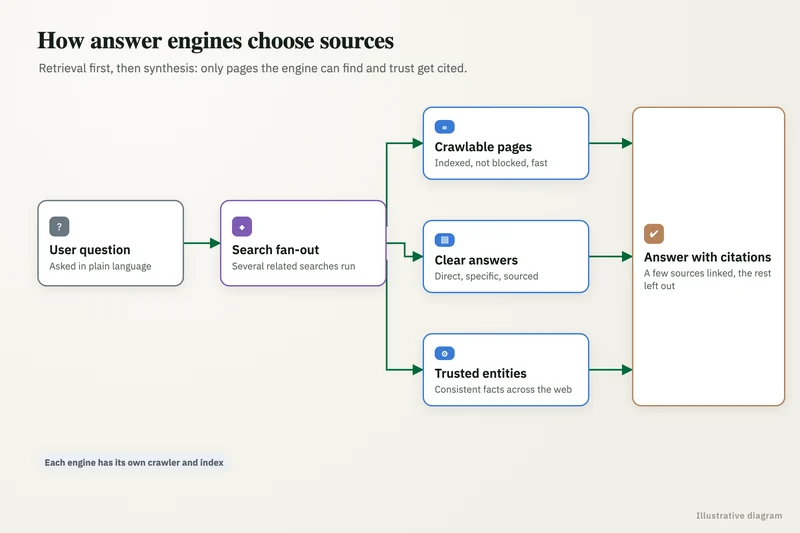
Each one reaches the web differently, which is why the work is not a single checklist. Google AI Overviews and AI Mode are fed by Googlebot and Google's index. ChatGPT search relies on OpenAI's OAI-SearchBot crawler. Perplexity uses PerplexityBot. Copilot draws on Bing, crawled by Bingbot. Claude's search uses Claude-SearchBot. If a robots.txt rule or a CDN setting blocks one of those agents, that engine has far less to work with when it writes about you.
- Google AI Overviews and AI Mode: Googlebot and the Google index.
- ChatGPT search: OAI-SearchBot, with ChatGPT-User for fetches a user requests.
- Perplexity: PerplexityBot, with Perplexity-User for user-triggered fetches.
- Microsoft Copilot: Bingbot, with no separate Copilot crawler.
- Claude: Claude-SearchBot, with Claude-User for user-requested pages.
How do answer engines decide which sources to cite?
No engine publishes a full ranking formula, but the documented mechanics point the same way: an engine can only cite pages it can fetch and parse, and it tends to quote passages that answer a sub-question cleanly. OpenAI states it does not publish how ChatGPT ranks sources, so anyone claiming to know the exact recipe is guessing.
Google's documentation for AI features describes query fan-out: the system may run several related searches across subtopics, then show supporting links. A single buyer question can therefore pull in a definitions page, a comparison page and a pricing page from different sites. Pages that answer one clear question near the top, with the detail underneath, give the engine an easy passage to lift.
Ranking well in classic search helps but does not settle it. An Ahrefs study found only 12% of URLs cited by AI assistants rank in Google's top 10 for the original prompt, which tells you the engines look well beyond page one. Brand mentions on review sites, forums, video platforms and trade press feed into which names an answer includes.
Is AEO just SEO under a new name?
Partly, and Google says so directly. Its AI optimization guide, updated in July 2026, states that optimizing for generative AI search "is still SEO" and that no special files, markup or Markdown are needed.
That is why we treat crawlability, indexing, page quality and internal linking as step one. A page that is not indexed and eligible for a snippet cannot appear in AI Overviews; Google's own documentation says there are no additional requirements beyond that. What AEO adds on top is a sharper focus on the questions buyers type into chat tools, passage-level answers, consistent entity data across the web, earned mentions in the places these engines read, and measurement built around citations rather than rank positions.
What does AEO work actually involve?
A typical program has five strands that run in parallel once the foundations are fixed. The weight given to each depends on the business, the engines its buyers use and where the gaps are.
The order matters. There is little point rewriting fifty pages into answer-first format if Cloudflare is quietly returning errors to OAI-SearchBot, and little point chasing Reddit threads if your own site contradicts your G2 profile on what the product does. We start with access and facts, then content, then mentions, and keep tracking running from the first week so every change has a before and after.
- Crawler access: robots.txt rules for OAI-SearchBot, PerplexityBot, Claude-SearchBot and Bingbot, Cloudflare AI crawler settings, server-rendered HTML and server log checks.
- Answer-first content: question-style headings, a direct one or two sentence answer under each, FAQ blocks, comparison pages and visible last-updated dates.
- Entity consistency: Organization schema with sameAs links, matching facts on Wikipedia, Wikidata, G2, Capterra, Yelp or Google Business Profile where they apply.
- Mentions: genuine presence on Reddit, YouTube, LinkedIn and industry publications, plus original data others want to quote.
- Tracking: a fixed prompt set run on a schedule, citation share in Bing Webmaster Tools, Search Console's generative AI report and AI referrals in GA4.
Why does AEO matter for traffic and leads?
Because the audience is already there and clicks behave differently when an AI summary appears. Google reported at I/O in May 2026 that AI Overviews has more than 2.5 billion monthly users, and TechCrunch reported in February 2026 that ChatGPT had 900 million weekly active users.
Pew Research found that people clicked a result on 8% of Google visits that showed an AI summary, against 15% of visits without one. If fewer people click, the brands named inside the answer collect a larger share of attention, and a buyer may form a shortlist before ever reaching a website. For a B2B company that shortlist is often the whole game.
None of this makes classic search irrelevant. It means the same buyer now meets your category in two places, the list of links and the written answer, and you want to show up credibly in both.
How do you measure whether AEO is working?
You measure AEO with a mix of first-party reports and a repeatable prompt test. Rank tracking alone misses most of it.
Google added generative AI performance reports to Search Console in June 2026, and AI feature traffic is counted under the Web search type. Bing Webmaster Tools offers an AI Performance report covering citations in Copilot, with citation share added in June 2026. In GA4, referral sources such as chatgpt.com, perplexity.ai, copilot.microsoft.com and gemini.google.com show visits that started in an answer engine. On top of that, we run a fixed set of buyer prompts in each engine every month and record which brands and URLs get cited, so changes are compared against the same baseline.
What can AEO not promise?
AEO cannot promise that any engine will cite you on a given prompt. Answers vary by user, by mode and over time, and no one can promise a citation.
Be wary of shortcuts sold as levers. Google says structured data is not required for generative AI search and there is no special schema for it, though schema still helps general SEO when it matches visible content. The llms.txt file has not been confirmed as an input by any major answer engine. Google's guide also warns against manufacturing inauthentic mentions. Good AEO is steady, measurable work on access, clarity and reputation, reported honestly month by month.
FAQ
Frequently asked questions
What does AEO stand for?
AEO stands for answer engine optimization. It refers to the work of helping AI tools like ChatGPT, Google AI Overviews, Perplexity and Copilot find, understand and cite a brand's content when they answer questions.
Is AEO the same as GEO?
In practice they describe nearly the same goal. GEO, or generative engine optimization, is often used for content-level work on generative answers, while AEO is a wider umbrella that also covers technical access, entities and measurement. Most agencies use the terms interchangeably.
Do I need AEO if my SEO is already strong?
Strong SEO is the best starting point, since Google says AI search optimization is still SEO. The gaps usually sit elsewhere: AI crawlers blocked at the CDN, pages that bury the answer, inconsistent company facts across directories and few mentions on the sites answer engines quote. An audit shows which of those apply.
Can an agency get my brand into ChatGPT answers?
An agency can improve the conditions that make citations more likely, such as crawler access, clear answers and earned mentions. No one can promise a citation, because OpenAI does not publish how ChatGPT ranks sources and answers change over time. Honest agencies report citation share against a fixed prompt set instead.
How do I see AI traffic in Google Analytics?
In GA4, look at session source for referrers such as chatgpt.com, perplexity.ai, copilot.microsoft.com and gemini.google.com. Grouping them into one custom channel makes the trend easy to follow. Google AI Overviews traffic is not split out in GA4; it appears in Search Console under the Web search type.
Keep reading
Related pages
Get started
Find out what AI says about you
Send your website and three questions your buyers ask. Within one business day we reply with how ChatGPT, Google AI Overviews and Perplexity answer them today, who they cite instead of you, and a fixed-price plan.
- Free AEO visibility check
- Fixed quote before any work starts
- Measured on citations and AI referrals, not promises
Prefer email? info@aeoservicesagency.com
Get a free AEO visibility check
Two lines is enough to start.